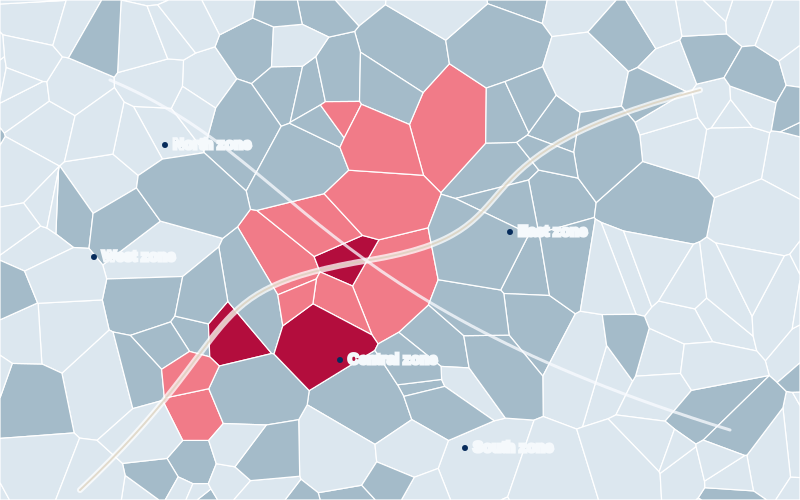
A closer look at location intelligence
How AdMapia can reduce wasted Google Ads spend
Geographic targeting is often much broader than keyword, audience or bidding optimisation. A campaign may cover an entire service radius even when the commercial opportunity varies considerably between neighbourhoods. Campaign averages can hide those differences.
AdMapia can analyse how spend, enquiries and available sales outcomes vary by location, then add postcode and property context. The aim is to identify where budget may deserve to be increased, reduced or tested. We distinguish a promising signal from a conclusion that needs more evidence: small samples, seasonality and changes in campaign activity all affect interpretation.
An opportunity map is a prioritisation tool, not a promise of savings. Recommendations should be tested against your current approach, with enough data to judge their effect on the outcomes that matter to your business.
How AdMapia can help generate more qualified enquiries
Cheap leads are not always the best leads. A postcode that generates many low-cost forms may deliver fewer suitable appointments or completed installations than an area with a higher initial cost per enquiry.
If you supply qualified-lead, sales or CRM data, AdMapia can compare those outcomes geographically and investigate which locations are associated with stronger commercial results. Agreeing what counts as a qualified enquiry is an important first step, whether that is an eligible property, an attended survey or another stage in your sales process.
Where outcomes cannot yet be connected reliably to advertising, the starting point is a measurement plan. Better location decisions depend on understanding lead quality, rather than simply maximising the number of submissions.
Improve Google Ads ROI with smarter location targeting
Google Ads location performance can be combined with postcode and property intelligence to reveal geographic patterns hidden inside campaign averages. This adds context to the relationship between advertising spend and commercial results.
A practical review looks at cost per acquisition, conversion rate and lead quality together. Where sales values are available and attributable, return on ad spend can add a further view. Revenue-based ROAS is not the same as profit, so margins and installation capacity also matter when choosing where to invest.
Location recommendations complement your keyword, creative and bidding strategy. The objective is to make geographic budget decisions more informed and testable, with results assessed over an appropriate period rather than inferred from an attractive map.
Find more locations like your best customers
The process starts with your existing customer or qualified-lead locations. These are matched to postcodes and enriched with relevant property and location information. We investigate common characteristics among stronger outcomes, then look for other postcode areas with similar profiles.
The sequence is: customer or lead locations → postcode matching → property and location enrichment → common characteristics → similar postcode areas → testable geographic targeting selections for Google Ads, subject to the locations available in the account. These are geographic recommendations, not an uploaded list of identified households or a guarantee of individual interest.
A location that resembles your best-customer areas is a candidate for testing. The analysis should consider coverage, data quality and the possibility that existing marketing activity influenced where those customers came from.
Different services can require different location strategies
Solar installations, battery retrofits, combined solar and battery systems, heat pumps and EV-related services may have different location profiles. Treating all enquiries as one market can obscure patterns within each service.
AdMapia helps each company discover patterns in its own data. Where records identify the service requested or purchased, we can compare geographic outcomes separately and explore which property and location characteristics are relevant. We do not assume that one property type or neighbourhood profile is universally best for a particular technology.
Separate recommendations can help you plan campaigns around your actual service mix, installation capacity and commercial priorities. Where there is too little evidence for a service, a focused test can be more useful than a confident-looking prediction.
Test AdMapia targeting with a Google Ads A/B experiment
Campaign A represents your existing geographic targeting. Campaign B uses an AdMapia-selected postcode targeting set, mapped to the geographic options supported by Google Ads. Keep other major variables — including creative, keywords, bids, budget and measurement — as comparable as practical.
The experiment design matters. Overlapping geographies can create competition or contaminate comparisons, while different areas may have different underlying demand. Agree an appropriate experiment or matched-area design, avoid unintended overlap, and document the limitations before launching.
Compare CPA, conversion rate, qualified leads, sales and ROAS where reliable values are available. Choose a primary success measure, an adequate test period and a way to account for delayed sales outcomes. This lets your company validate whether the recommendations create measurable improvement. A test can also show no meaningful difference or a worse result; the next decision should follow the evidence.
Discover growth opportunities inside your existing service area
You do not necessarily need to expand your radius to find new opportunities. Under-targeted postcode areas may already sit within your existing service territory, close enough to fit your installation routes and operating capacity.
AdMapia can help identify areas worth prioritising, testing, monitoring or deprioritising. Existing performance, location characteristics and the strength of the available evidence should inform those categories. An area with little historic activity may deserve a test rather than being written off as low potential.
The same approach can support decisions about entering new towns, opening a branch or extending Google Ads coverage. Compare potential with travel time, operational constraints and local competition before committing significant budget. Location analysis supports those decisions; it does not replace commercial judgement.
Use your existing customer data as a competitive advantage
Competitors can access similar keywords, bidding systems and Google Ads automation. They do not have your exact customer history, lead history, sales outcomes, geographic performance or CRM information. That first-party knowledge can provide a valuable starting point for a more relevant location strategy.
AdMapia helps turn this information into a repeatable process: connect outcomes to locations, investigate patterns, select areas to test and feed the results back into the next decision. As the quality and completeness of your records improve, the analysis can become more informative.
Start with the minimum information needed for the agreed analysis. Postcodes and aggregated outcomes may be sufficient for an initial discussion; customer names and personal contact details are not needed in an enquiry form. Any subsequent data transfer should use an agreed secure process.
Where should your next Google Ads budget be spent?
A Location Opportunity Report starts with information your business already has: your service area, customer locations, lead data, Google Ads performance and, where available, sales or CRM outcomes. AdMapia enriches this with postcode, property and location intelligence to investigate where the strongest opportunities may lie.
The useful output is a set of clear recommendations to discuss, test and act on — with the supporting evidence and any limitations made visible. That might mean focusing more budget on a promising area, testing a similar location or improving measurement before making a larger decision.
Tell us which services you provide, where you operate and what you want to improve. We can then agree what data is available and the appropriate next step for your business.
Request a Location Opportunity Report →